
Greystoke
OS Grid ref:- NY 435309
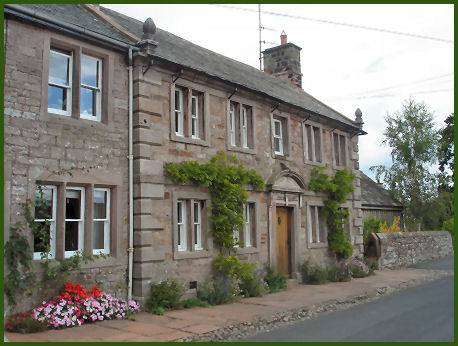
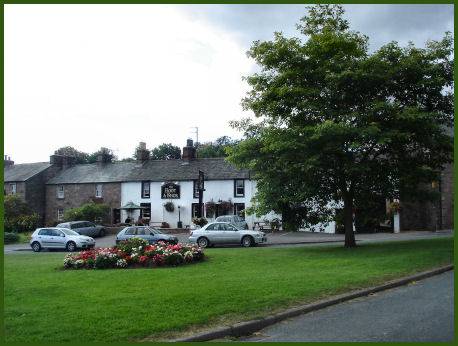
The immaculate village of Greystoke, set in magnificent scenery, lies on the old Roman road which ran from Keswick to Penrith, amidst hills sweeping up to around 1,200 feet.
St. Andrew's Church
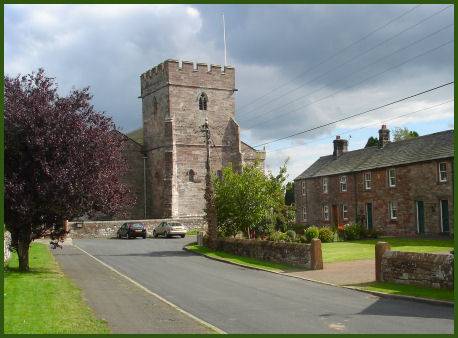
One of the villages most attractive buildings is St. Andrew's Church with its magnificent medieval stained glass east window. The church dates from the 13th century but was largely altered in the 15th century.
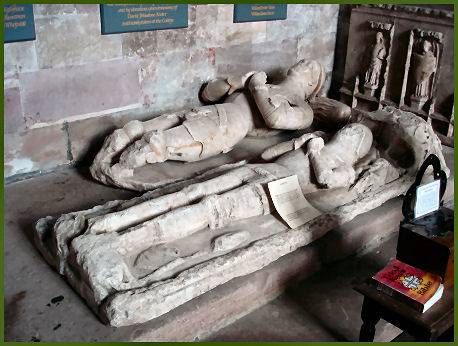
The church contains the Derbyshire alabaster effigies of William de Greystoke the 2nd Baron Greystoke (died 1358) and John de Greystoke 4th Baron Greystoke (died 1436). The smaller figure, representing the 2nd baron, has a canopy and the hands are held in the attitude of prayer. The larger figure, depicting John de Greystoke 4th Baron Greystoke, is broken at the knees. The sword has disappeared and the head is resting on a great helm. John de Greystokes's effigy displays a Lancastrian SS collar (collar of Esses) The panels at head and feet are the original tomb chest ends and date from the same period.
Beyond the church gates is a medieval sanctuary stone, where the medieval right of sanctuary inside the churches boundaries could be claimed by offenders. The stone is protected with an iron grille.
Greystoke Castle
Imposing Greystoke Castle, to the north-west of the village was built around 1353 and was once part of a border chain of fortifications.
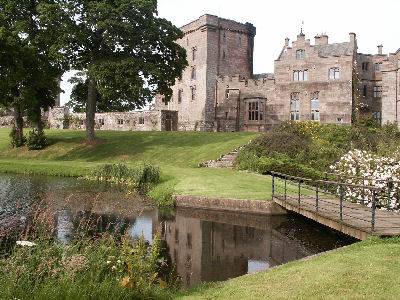
The castle was badly damaged during the Civil War, but was almost entirely rebuilt by Henry Howard in the nineteenth century. Greystoke Castle is surrounded by a park of nearly 6,000 acres which is stocked with deer. Greystoke Castle is not open to the public.
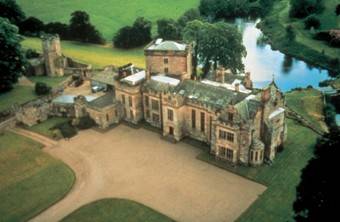
Images courtesy of Greystoke Castle
The stone gateway of Greystoke Castle opens to the village green which is lined with buildings of distinctive local pale red stone many of which date from the 17th century.
Just to the east of Greystoke stands an extraordinary building, Fort Putnam, a folly built by the eleventh Duke of Norfolk.